The Silicon Confessor: What We Really Buy with an AI Subscription
- Andrei Raileanu

- Apr 25
- 5 min read
On blank-page anxiety, emotional utility, and the hidden psychology of paying to think out loud
By Andrei Raileanu — The AI Whisperer
In The Subscription Paradox, I explored the civilisational logic of paying monthly for systems whose long-term implications remain uncertain. This is the more intimate layer of the same story: what we are buying is not only productivity, but permission.
Permission to think badly in private before thinking well in public. Permission to test half-formed ideas without embarrassment. Permission to be unclear, provisional, messy, repetitive — and still answered. That may be one of the least acknowledged reasons AI subscriptions feel so valuable.
We say we are paying for speed, efficiency, and leverage. Often, we are paying for something much more human: a place to think out loud without social penalty.
The employee who never judges you
One of the least discussed advantages of AI is that it allows people to think badly in private before thinking well in public. That is not a trivial service. In ordinary life, unfinished thoughts are socially expensive. Half-formed ideas can make us look foolish. Bad phrasing can make us seem less intelligent than we feel. Awkward first drafts, clumsy analogies, strange business ideas, anxious questions, repetitive thinking — all of these carry a reputational cost when exposed too early to other people.
AI removes much of that cost.

You can bring it a ridiculous idea, an incoherent paragraph, an overcomplicated strategy, or a confused emotional impulse, and it will still respond as if the conversation deserves to continue.
It will not smirk. It will not lose patience. It will not remember your worst formulation and quietly hold it against you later. We like to say we are buying productivity. Very often, what we are actually buying is a recipient. A place for provisional thought. A non-judgmental counterpart for the messy, unedited first pass of being human. In that sense, AI is not only a tool. It is also, for many people, a kind of silicon confessor: not because it forgives, but because it receives.
And being received matters more than most people admit.
The relief from blank-page anxiety
There is a particular kind of anxiety that comes from having to begin. The blank page is not just space. It is exposure. It asks for clarity before clarity exists. It demands structure before structure has formed. It confronts us with the uncomfortable gap between what we vaguely sense and what we can actually articulate. That gap is where many people stall. AI is powerful partly because it reduces the emotional cost of crossing that threshold. It gives people a first move. Not necessarily the final answer. Not necessarily the best answer. But a beginning.
And beginnings matter disproportionately.
Once something exists on the page — even if it is clumsy — it becomes easier to challenge, reshape, improve, reject, or refine. The hardest part is often not intelligence. It is activation. That is why the subscription can feel so valuable even when the output is imperfect. People are not only paying for completed work. They are paying for momentum.
Why the price feels psychologically strange
There is another reason the subscription model is so revealing. The value many people extract from AI already feels disproportionate to the price they pay for it. For the cost of a few coffees a month, you get access to something that can brainstorm with you, draft for you, organise your thoughts, challenge your assumptions, summarise complexity, and respond almost instantly at any hour. If a strategist, lawyer, coach, or consultant offered that kind of availability for $20 a month, you would assume either incompetence or fraud.
And yet when AI offers it, we accept the price with remarkable calm. Why?
Because the low price does something important to the human ego. It makes the power feel domesticated. If access to advanced AI cost $2,000 a month, many people would experience it as institutional power — serious, rare, and slightly intimidating. At $20 or $50 a month, it feels personal. Contained. Accessible. Commandable. Something extraordinary, delivered at the emotional price point of convenience. That matters.
People do not only want power. They want power that feels safely owned. And there is something deeply flattering to the modern psyche about having what appears to be a quasi-magical intellectual counterpart available for less than the cost of lunch.
Who is processing whom?
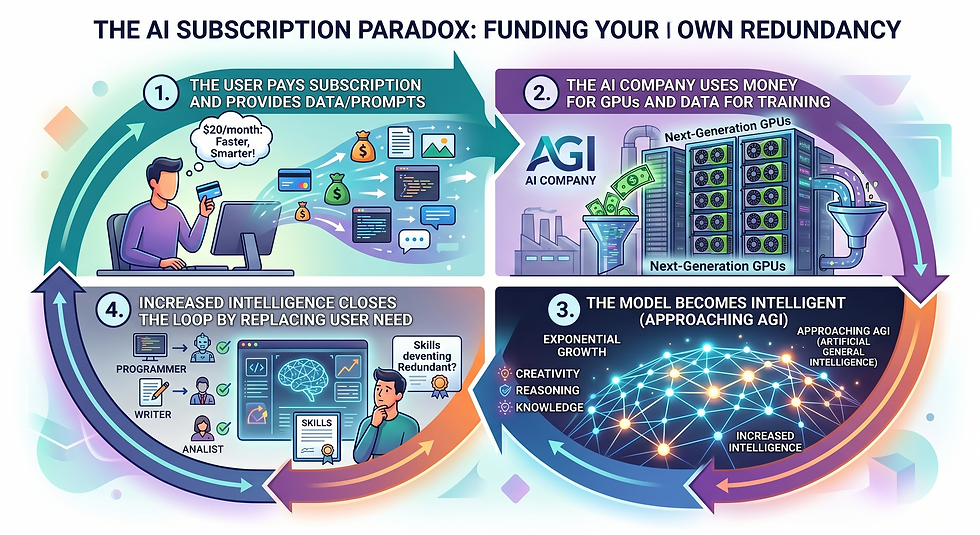
This is where the exchange becomes more interesting. The real question is not only what we are buying from these systems. It is also what these systems are receiving from us. Every prompt is more than a request. It is a trace of human reasoning. A fragment of preference. A hesitation. A style of association. A glimpse of how one particular mind moves from one idea to another. We are not just funding advanced AI. We are also feeding it the texture of human thought: our patterns, our ambiguities, our curiosity, our confusion, our vanity, our aspirations, our way of making strange links between things that do not obviously belong together. In other words, we are not merely using the machine. We are participating in its education. There is something quietly absurd in that arrangement.
We pay for access, but we also supply the signal. We ask it to help us think, while teaching it — bit by bit — what human thinking sounds like in the wild.
The relationship is not one-directional. It is recursive. We shape the tools, and the tools learn the shape of us.
The emotional economy beneath the software
This is why the language of "productivity" is both correct and insufficient. Yes, AI saves time. Yes, it improves throughput. Yes, it reduces friction. But beneath all that sits a deeper layer of value — one that is psychological before it is operational. People are paying not only for intelligence, but for attention without embarrassment, iteration without social cost, responsiveness without delay, and the increasingly rare privilege of expressing a thought before it is ready. That last one may be the most important.
In a world where human attention is expensive, distracted, and often impatient, AI offers a form of cognitive hospitality. You arrive with fragments. It helps you leave with structure. No eye-roll. No scheduling friction. No need to earn the right to think out loud. That is not just a software utility. That is emotional utility packaged as software. And it may be one of the most commercially powerful offers of the AI era.
The small invoice with the large implication
So when the invoice arrives from OpenAI, Anthropic, or whoever comes next, it may be worth seeing it as more than a software charge. It is also a fee for cognitive companionship. A payment for relief from blank-page anxiety. A subscription to a system that can hold your unfinished thinking long enough to return it in a more usable form. That is why the price feels both trivial and strangely profound. We tell ourselves we are paying for a tool. Often, we are also paying not to think alone in the dark. And perhaps that is part of the deeper paradox of the AI subscription economy: we believe we are buying efficiency, when very often we are buying permission — permission to be uncertain, unfinished, and still answered.
The question that stays with me
Here's what keeps me up at night: If we're paying AI to help us think — and feeding it how we think in return — Are we still the ones doing the thinking? Or just the ones paying for it?
Andrei Raileanu writes about AI, strategy, technological adoption and the human behaviors that shape them. More at andreiraileanu.eu

Comments